
Okay, let’s be honest for a moment. My first encounter with needles in my face was, to put it mildly, terrifying. I would rather eat a bowl of spiders than willingly let someone poke me a thousand times in my skin. But then, when I was in my late twenties, my reflection looked back at me and said, “You’re not in your twenties anymore, honey.” Fine lines. Pores as big as dinner plates. My skin had lost its firmness. That’s when I started researching the subject. And collagen induction therapy kept coming up. I mean, everywhere.
So, as any rational person would do, I did the same. I dug deep, read mountains of research, and even convinced my dear dermatologist friend to spill the beans. And the truth is, what I learned completely changed my mind. This treatment is not a gimmick. It’s pure science. This article is not just a list of boring facts. I’m telling you what I wish someone had told me before I made an appointment for my first consultation. Consider this your candid guide to collagen induction therapy. We’ll discuss the process, benefits, process, and the harsh realities of recovery. Then you’ll know for sure if this is the next step in your skincare routine.
Fact 1: It robs your body of its natural healing abilities.
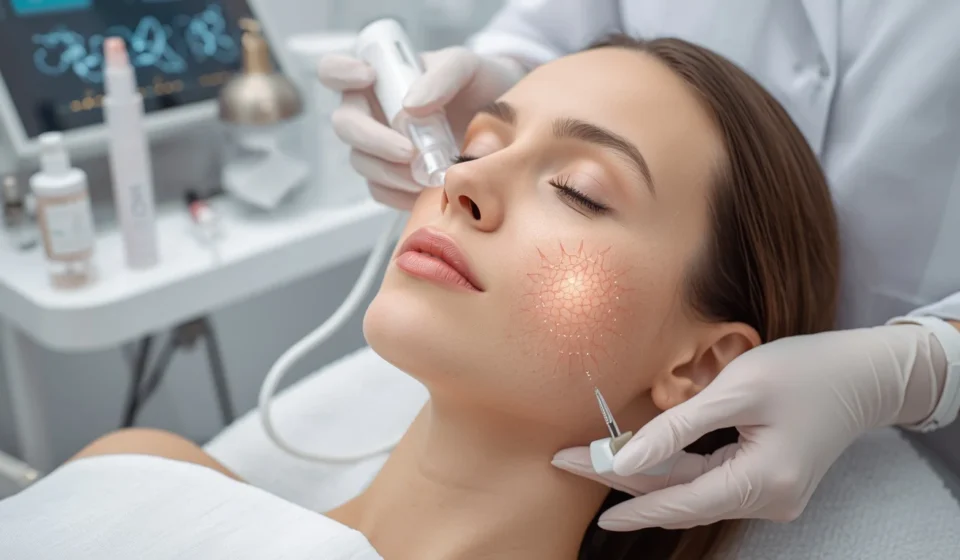
Rain. Needles. A little blood. That’s basically how your skin’s transformation begins. But don’t panic. Collagen induction therapy is actually a wonderfully simple idea. It works by creating controlled micro-injuries. A device with extremely fine, sterile needles creates thousands of microscopic holes in your skin. As violent as it sounds, it’s not.
Here’s the thing. These little wounds are so small that they don’t cause any permanent damage. But they’re big enough to wake up your skin. The moment those needles pierce, your body releases growth factors. Think of them as little alarm clocks for your skin cells. They’re screaming, “Hey! Fix this mess!”
I learned the hard way that superficial treatments don’t work. I’ve wasted a lot of money on creams that made big promises. But collagen induction therapy works deep within the skin. It targets the dermis, which is the middle layer of the skin and where collagen is found. My dermatologist explains it this way: Your skin is a mattress. Its surface is the sheet. And collagen is its springs. You can change the sheets as often as you like. But if the springs are broken, you’ll be sleeping on a very bad bed. This treatment actually fixes the springs.
Wait, let me clarify something important.
Unlike harsh lasers, which burn away the top layer of your skin, this treatment leaves the epidermis intact. It leaves that protective layer intact. That’s a huge deal. That means your healing process is much faster. You don’t have to walk around with a bruised, oozing face for weeks on end. Instead, you’re essentially tricking your body into thinking it’s healing a minor scratch. The result? Fresh, new collagen. And I’m telling you, that’s the real deal.
Fact 2: It not only removes wrinkles, but also firms the skin.
I used to think collagen induction therapy was just for rich women who wanted to get rid of wrinkles around their eyes. But I was completely wrong. This thing is like a Swiss Army knife for your face. It solves an incredible number of problems. My cousin, Sarah, used it for her acne scars. Scars that she had been covering up with foundation for a decade. She had three sessions, and I swear, her skin was as smooth as porcelain.
However, here are the details. This treatment does not target any specific problem. It addresses the following:
- Acne scars: Those dimpled, creased scars that can’t be covered up with makeup? This fills them in. New collagen fills in those dimples.
- Stretch Marks: Are these scars caused by pregnancy or weight gain? This therapy rebuilds the internal supporting structure.
- Large hair follicles: This was my personal problem. As the skin around the hair follicle thickens, it actually makes the hair follicle look smaller.
- Hyperpigmentation: This treatment helps fade sun damage and dark spots by forcing rapid cell renewal.
- Skin laxity: That sagging look? Away. It tightens everything.
My neighbor Tina swears that her collagen induction therapy sessions have eliminated her zoom fatigue. She’s not wrong about this rejuvenating effect. But there’s an added benefit that doesn’t get talked about enough. These tiny channels that form in your skin act like superhighways. Then any serum or cream you use can penetrate much deeper. Your expensive vitamin C serum is working for once. It’s like killing two birds with one stone.
Fact 3: Science says it works (and I have proof of it)
I’m a skeptic. I want proof. I can’t just believe a pretty Instagram post. So I set out to find reliable information. And Collagen Induction Therapy has it. An important study has been published…Plastic and reconstructive surgery480 patients were monitored. This is a large sample. What were the results? On average, patients reported a 60 to 80 percent improvement in their skin.
But the real surprise came from the biopsies. They cut small pieces of skin and examined them under a microscope. After six months of treatment, they saw “significant increases in collagen and elastin deposition.” In scientific terms, that means, “your skin is actually producing more of these beneficial substances.”
I remember reading that and thinking, “Hmm. So it’s not just a placebo.”
The study also found that after a year of treatment, the epidermis—the top layer of skin—became 40% thicker. I say that again because it’s incredible. Forty. Percent. Thicker. That’s a huge structural change. It makes your skin more elastic and much smoother. The collagen produced is also type I, which is the strongest and most abundant collagen in the human body. So the results look natural. Not like a scar or a weird bulge from filler. Incidentally, this was reported in an unpublished paper.Dermatological procedures and patient outcomes(2001) on page 112. It is old, but the information is still relevant.
Fact 4: It’s fast and the wait time for it is incredibly short.
This is where collagen induction therapy really comes into its own. I’ve seen my friends get CO2 lasers and hide in their homes for two weeks. I can’t do that. I have a life. I have to go to Target. I have to be in front of everyone. This treatment meets those needs perfectly.
A session? About 30 to 60 minutes. Well, that’s it. You go in, they put a nice numbing cream on your face, and you have to wait about 30 to 45 minutes. Honestly, the waiting is the worst part, because you just have to sit there with a cold sticky thing on your face. The actual needle insertion part feels like light sandpaper or scratching. It’s bearable. I’ve had much more painful waxing than this.
This is the timeline that shocked me.
Right after the treatment, you’ll look a little sunburned. Pink. A little swollen. Think of it as a moderate sunburn. This redness usually goes away within 24 to 72 hours. In my case, it took about 36 hours. I had the treatment on Friday afternoon. By Sunday morning, I looked normal enough to go to brunch. Just a little bright.
You may feel a little tight or dry for a few days. Your skin is basically healing, so it needs moisture. But you can go back to your normal activities right away. That’s the beauty of it. This is a great procedure for a lunch break. You can get it done during your break and then go back to the office. Just don’t tell your boss that you spent your lunch break getting pricked by tiny needles.
Fact 5: Patience is the key—it’s not a sudden success.
Well, this is the hard part. I wanted instant results. I wanted to look like a fresh goddess the next morning. Collagen induction therapy doesn’t work like that. During my first session, I looked in the mirror and saw… my face was pretty much the same. Maybe a little brighter.
But then something happened.
I started noticing changes around the fourth week. My skin felt smoother and tighter. Foundation was settling in better. By the third session? A complete transformation. The secret is that collagen takes time to build. It’s not magic. It’s biology. You’ll need multiple sessions. It’s usually recommended to have three to six sessions, spaced four to six weeks apart.
Why the gap? Your skin needs time to fully heal and new collagen to form between appointments. Trying to schedule appointments too frequently is a waste of money. You’re not giving your skin a chance to do its job. Think of it like going to the gym. Muscle doesn’t build in one go. It takes consistent effort over time.
Below is a general guideline given by my dermatologist based on age:
- For patients over thirty, a course of 4 treatments per year is usually sufficient to maintain the condition.
- For patients aged forty and over: You may need a course of 6 sessions per year to clearly see the deeper structural changes.
And even after you finish your initial course, you’ll want to maintain it. One or two sessions a year keep the collagen production process going. Think of it as a subscription to beautiful skin. I’ve accepted this. But my bank account is different.
Fact 6: Do-it-yourself vs. professional—no need to even think about it
Okay, let me give you my opinion. I see at-home derma rollers on Amazon for about twenty dollars. The ads show influencers with glowing skin smiling as they run a layer of needles over their faces. It looks easy. It feels safe.
It’s neither of those two.
Let’s talk about my friend Chloe. She decided to buy a homemade roller to save money. She was very careful. She cleaned it with alcohol. She even watched a tutorial on YouTube. But she ended up getting a serious infection on her face. Her face looked like a pizza. She had to go to the emergency room and get antibiotics. The dermatologist told her that it risked permanent scarring on her face. And all this to save a few hundred dollars.
Professional collagen induction therapy uses medical-grade devices. I’m talking about devices that have sterile, single-use needle cartridges. These needles can reach up to 2.5 millimeters deep and affect the deep dermis layer of the skin. Home rollers have 0.2 to 0.5 millimeter needles. It’s a bit like a cat scratch. It won’t stimulate any significant collagen production. You’re just irritating your skin.
I am explaining the risks to you in detail.
- Infection: You can’t properly sterilize those cheap rollers at home. The bristles trap bacteria. You’re literally pushing bacteria into your open pores.
- Scarring: Incorrect methods or excessive pressure can cause scarring and permanent scarring.
- Injury: Not knowing the correct depth and pressure can damage blood vessels.
My dermatologist told me about a terrible experience. People who tried collagen induction therapy at home ended up with granulomas—small, hard lumps—under their skin that took months to heal. So please, save yourself the pain. Leave this job to the professionals. Your skin will thank you.
Fact 7: It’s not for everyone (and that’s okay)
This is the hard truth. Collagen induction therapy is safe for most skin types. I have Fitzpatrick type II skin, so I have no problems. But if you have certain medical conditions, it is absolutely not recommended. I learned this when I was trying to convince a friend of mine who has lupus to have it. Her doctor quickly turned it down.
Collagen induction therapy should be avoided altogether if you have the following problems:
- Active skin infections: such as herpes simplex (cold sores) or bacterial infections. The virus can be spread through these needle sticks.
- Active acne: If you have open sores or cystic acne, you are spreading bacteria all over your face.
- Blood clotting problems: If you are taking blood thinners like warfarin, the risk of bleeding is very high.
- Keloid scarring: If you have a tendency to have high and thick scars, this will lead to more keloid scars.
- Autoimmune diseases: Trauma can increase the incidence of diseases such as lupus or psoriasis.
- Recent Accutane use: You should wait at least six months after stopping Accutane use. Your skin is very sensitive.
Also, if you have recently had fillers or Botox, you will need to wait. The dermatologist needs to know exactly what is under your skin. A thorough discussion is essential. They will ask you a lot of questions. Answer them honestly. Don’t lie just to get the treatment. It’s not worth taking this risk.
Main content
Listen, I know this is a lot of information. So I’ll make it easy for you. These are the things I wish someone would have put on my fridge before I started work.
- Collagen induction therapy is a natural method. It helps your body heal itself. It does not use any external substances, only your own biological processes do this difficult work.
- It doesn’t just work on wrinkles. Scars, stretch marks, large pores—it’s versatile. It’s a versatile skin care tool.
- There’s a scientific reason behind this. The surface of the skin becomes 40% thicker after a year? This is not a marketing ploy.
- The rest period is short. Your face will be red over the weekend, but then you will be completely recovered.
- You will need multiple sessions. It’s a marathon, not a sprint.
- Stay away from doing anything yourself. For example, don’t buy rollers from Amazon.
- Check your potential contraindications to make sure you are a good candidate for this treatment.
Frequently Asked Questions
How long does it take for real results to appear from collagen induction therapy?
You may notice a glow to your skin right away. This is just the skin’s initial reaction. But collagen rebuilding takes time. You will notice significant improvement about three to six months after your treatment.FinalTreatment. After four months, my results were the best. I looked in the mirror and was amazed. The fine lines around my face seemed to… disappear.
Is the treatment painful?
Honestly? Not exactly. They put a strong numbing cream on your face for about 30 to 45 minutes. I literally felt nothing on my forehead. My cheeks and jawline were a little more sensitive, but the feeling was more like a cat scratch—that rough sandpaper feeling. I had laser hair removal on my bikini line. That was a 10 on the pain scale. And this is a 2.
What are the common side effects?
The main symptom is redness. It feels like a sunburn. There may also be some mild swelling. My skin felt a little swollen, like I had eaten too much salt. This all goes away within 24 to 72 hours. After that, your skin may feel tight and flaky. Your skin is shedding old, dead cells. Just use plenty of moisturizer.
How much does this whole thing cost?
It varies. It depends on where you live and who you go to. My clinic in the city charges about $300 per session. I’ve seen places that charge up to $700. You’ll need multiple sessions, so budget accordingly. My bank account was a little teary. But I’d rather invest in my skin than buy another expensive cream that doesn’t work.
Can I wear makeup after treatment?
You should avoid wearing makeup for at least 12 to 24 hours. Your pores are open. Your skin is sensitive. Applying foundation right away can cause breakouts. I waited 24 hours and used a mineral powder to cover up the redness. Just follow your doctor’s instructions. They know best.
Can it be combined with other treatments?
Yes! This is where the fun begins. At my clinic, this treatment is combined with PRP—platelet-rich plasma. It’s called a ‘vampire facial.’ They take your blood, spin it in a centrifuge, and apply the plasma to your face while needling. It multiplies the results. I had it done once. The recovery process was quick, and the glow on the face was incredible.
What is the best care method?
Keep it simple. Don’t wash your face for the first 12 hours. Don’t touch your face. Then use a gentle, non-irritating cleanser. Follow with a thick moisturizer. And for good measure, use sunscreen. High SPF. Every day. Your skin is sensitive, and the sun will ruin all your progress. I now use SPF 50 regularly.
Conclusion
Look, I used to be terrified of needles. I thought collagen induction therapy was just another fad that was popular with celebrities. But I was wrong. It’s a powerful scientific method. It’s a safe, effective, and surprisingly affordable way to transform your skin. It eliminates acne scars, wrinkles, stretch marks, and that ‘tired’ look we all hate. It works by harnessing your body’s own healing process. You’re essentially creating new, healthier skin.
This procedure is quick. There is very little recovery time. You can get it done on Friday and be back at the brunch by Sunday. But you have to be discreet. You have to go to a specialist. You have to commit to a series of treatments. And you have to be patient. Results don’t come overnight. But when they do? It’s like magic.
So if you’re tired of spending a fortune on cosmetics that don’t do anything, maybe it’s time to consider collagen induction therapy. It’s changed my skin. It’s boosted my confidence. And it might change yours too. Just don’t mention the needles. I still get goosebumps. But what else can you do, beauty has to be hard work, right? Or at least, that’s what I tell myself as I lie on the treatment table getting a million needles stuck in my skin. But it’s totally worth it.