
Listen, I’m telling you the truth. I didn’t expect to fall in love with a place like this.Before I went to Vietnam, everyone was telling me about the vibrant life of Hanoi, Halong Bay, and Saigon. But the ancient city of Hoi An? It completely blew me away.
On a muggy Tuesday afternoon, I landed in Da Nang, took a taxi south, and forty-five minutes later the driver dropped me off at the edge of what looked like a time capsule. My first thought was:Did I just walk into a movie set?
Rain. Humidity. The air smelled of jasmine flowers and fish sauce. That was how my introduction to the ancient city of Hoi An began. And to be honest? I haven’t been the same since.
This beautifully preserved trading port on Vietnam’s central coast is more than just another destination on a backpacker’s itinerary. It’s a living, vibrant museum that feels both ancient and very much alive. Hoi An Ancient Town has only grown in appeal since UNESCO awarded it their much-coveted World Heritage status in 1999. But don’t be fooled—the place hasn’t lost a single bit of its essence.
Whether you’re a history buff like me, a foodie who builds their entire itinerary around mealtime, or just someone looking for the perfect Instagram photo, Hoi An Ancient Town won’t disappoint. Every time.
However, the truth is this. After wandering its labyrinthine streets for hours, eating my fill of kao lao, and surviving being crushed under a cycle rickshaw, I understand exactly why this place deserves a place on your travel bucket list.
Let’s get started.
1. You are essentially walking through a living history book.
The first thing you’ll notice about Hoi An Ancient Town is howOriginalIt seems so.
I know, I know—it sounds like travel book nonsense. But hear me out.
Between the 15th and 19th centuries, this quiet little riverside town was one of the most important international trading ports in Southeast Asia. We’re talking about Chinese merchants haggling with Japanese merchants. Portuguese sailors coming in from the South China Sea. Dutch and even Spanish ships would drop anchor right where you’re standing.
Through three centuries of political turmoil, war, and attempts at modernization, somehow—miraculously—the ancient city of Hoi An has survived almost intact.
My friend Dave, who came here a decade ago, told me that the place is still exactly as it was when he first saw it. The same yellow walls. The same tiled roofs. The same narrow streets, none of which make sense on Google Maps.
Walking through the old area, you can still see the distinctive architectural imprint of those foreign cultures. Chinese meeting houses with ornate dragon carvings. Japanese merchant houses with distinctive curved railings. French colonial villas that wouldn’t look out of place in Provence.
It’s a messy, beautiful combination that shouldn’t work, but does.
And the thing is—unlike many UNESCO sites that feel like theme parks, Hoi An Ancient Town is still very much alive. People live here. They work here. They raise their children, run businesses, and debate politics over morning coffee, just as they have done for centuries.
You’re not watching history from behind a velvet rope. You’re walking right through it.
2. The night lanterns are truly amazing.
Well, to be honest, I’ve seen a lot of beautiful sunsets in my life.
I watched the sun set below the horizon in Santorini. I took in the full experience of watching the sunrise at Angkor Wat (although, the trouble of waking up at 4am was worth it). But nothing—and I mean…Nothing—It prepared me for what happens in Hoi An Ancient Town after dark.
A magical event occurs at the moment the sun sets.
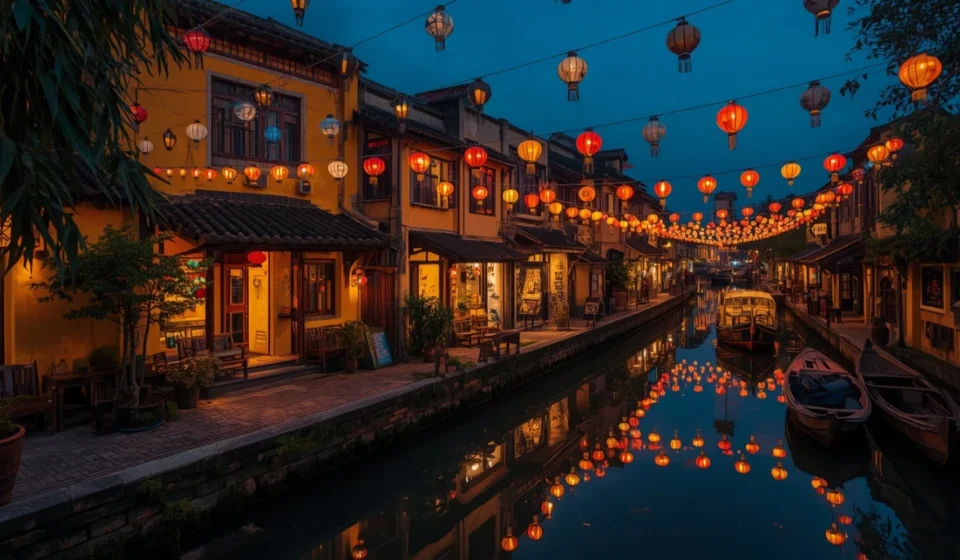
The electric lights dim. The crowds thin out a bit. And then, slowly, thousands of silk lanterns light up in every color you can imagine. Red. Gold. Pink. Purple. Blue. They hang from shop canopies, line the narrow streets, swing from balconies as if someone had scattered a packet of Skittles all over the city.
The reflection of all these bright spheres in the water of the Thu Ban River? Simply perfect. Truly simply perfect.
My girlfriend (now wife thanks to this trip) actually cried. She would deny it if asked, but I saw her tears. I have proof, including pictures.
But this is where things get even better.
The full moon lantern festival is extremely exciting.
If you are lucky enough to time your trip well, you will be able to enjoy the Full Moon Lantern Festival, which takes place on the 14th of every lunar month.
I had read about this before. I felt like I knew what was going to happen.
I was wrong.
On the night of the festival, the ancient town of Hoi An is completely plunged into darkness. There are no electric lights. The only light comes from silk lanterns and the silvery glow of the moon overhead.
The roads are closed to traffic. Locals dress up in traditional ao dai. Traditional music seems to be coming from somewhere, but it’s hard to tell. And locals, tourists, everyone—head toward the river.
You buy a small paper lantern. Light the candle inside. Make a wish.
Then you gently release it into the water, and watch as it merges with the hundreds of other twinkling lights floating with the current.
I’ll be completely honest with you—I’m not a spiritual person. I don’t pray. I don’t meditate. But standing on that bank of the river, watching my little lantern float away along with the hopes and dreams of others, something changed inside me.
It sounds old-fashioned. I know, it really is. But that’s exactly the feeling Hoi An Ancient Town gives you.
My wish? I’m not saying that. But my lantern went quite a ways before it finally went out, so I’m taking that as a good sign.
3. Its architecture will turn your head (in a good way)
Let’s talk about the buildings.
Because honestly, the architecture of Hoi An Ancient Town is simply amazing.
Traditional Vietnamese tube houses are long and narrow structures, built this way because property taxes were previously calculated based on street frontage. (Clever, right?)
Then there are the Chinese assembly rooms, which are opulent and colorful and decorated with so much red varnish and gold leaf that even a casino owner would be jealous.
And there are more—Japanese merchant houses with distinctive curved roofs and wooden latticework.
There are also French colonial villas that look as if they were lifted straight from Nice.
Amazingly, all these completely different architectural styles coexist in Hoi An Ancient Town as if they’ve been doing so forever. Because they really have.
Many old houses are open to the public. You can walk right inside, and for a small entrance fee (like 20,000 VND—less than a dollar), you can explore the houses where real merchants lived hundreds of years ago.
I remember one house in particular. It was called Tan Kee House. It had been owned by the same family for seven generations.Seven generations!The current owners showed me around the building and showed me how it incorporated elements of Japanese and Chinese design while maintaining its distinct Vietnamese characteristics.
My family somehow manages to fit a house for seven people.Year.
Standing in that dimly lit room, the wooden floorboards creaked underfoot, and I could almost hear the echoes of old business deals being struck, the chatter of families gathered at the dinner table, and the sounds of children running around in the corridors.
It’s an experience that makes you feel incredibly small.
And the streets? They were narrow. Crooked. Deliberately confusing. Which, I later learned, was intentional—apparently, ancient city planners believed that evil spirits could move more quickly on straight streets.
So they twisted everything.
The result is a maze where getting lost is a joy. Every wrong turn reveals something new. A hidden courtyard. A small temple. An old woman selling fresh spring rolls with a basket on her shoulder.
You don’t need a map in Hoi An Ancient Town. You just have to wander around.
4. The Japanese covered bridge will make you fall in love instantly.
You can’t visit Hoi An Ancient Town without seeing the Japanese Covered Bridge.
And I mean that literally—it’s basically the center of the city, the one that ties everything else together.
Built by the Japanese community in the early 1590s, this beautiful wooden structure connects the Japanese Quarter with the Chinese Quarter. It is covered by a tiled roof, has a small temple at one end, and contains a pair of statues of a monkey and a dog, which are said to guard the entrance.
Here’s a fun fact for you: The bridge was originally built to connect the Japanese and Chinese communities, because apparently relations between them weren’t very good and they needed a neutral meeting place.
Four hundred years later, tourists from all over the world now line up to take pictures there.
It has become such a symbol of Vietnamese culture that they even put it on the 20,000 VND banknote. That’s right—you can carry a piece of Hoi An Ancient Town in your wallet.
I sat by the bridge for about an hour, just watching people go by. Couples were taking selfies. Old monks were walking slowly, their robes blowing in the wind. Children were selling postcards for a pittance.
And you know what? Everyone seemed happy.
The bridge is old. It is slightly crooked. The wood has worn away from centuries of rain and humidity.
And it’s perfect.
5. This food will make you lose interest in everything else
Let’s tell you about the food in Hoi An Ancient Town.
Actually, let me start with a confession.
I’ve had Vietnamese food before. Many times. Pho in Hanoi. Bun Cha in Saigon. I’ve had spring rolls in about fourteen different countries.
None of this could have prepared me for what I saw in Hoi An.
The cuisine here is very different from the rest of Vietnam. And that’s because the ancient city of Hoi An has absorbed influences from every culture that has passed through its ports—Chinese, Japanese, Indian, French, Portuguese.
What is created as a result is completely unique.
Cao Lau: A noodle dish that can’t be imitated
Let’s start with the main attraction of the event, Kao Lau.
This is the specialty of Hoi An Ancient Town, and I tell you, your trip will truly be incomplete without trying it.
The noodles are thick, chewy, and light brown in color. They’re made with rice flour and water—but here’s the thing. Locals swear that the water must come from ancient Cham wells scattered throughout the area. No other water will do.
Is this true? I have no idea. But whatever the noodles are, they’re amazing.
They are served with pieces of pork, crispy fried rice crackers, fresh vegetables and a little broth that ties everything together. The taste is salty, slightly sweet and the texture is impressive.
I ate cao lau three times in my first two days in Hoi An Ancient Town. I didn’t have any stomach problems once.
White Rose: Dumplings that look so beautiful that you want to eat them
Then there are the “white rose” dumplings, locally known as ban bao ban bak.
These are tiny, delicate, transparent wrappers that look like real roses. They are made of rice paper and filled with shrimp and pork. Although the filling is simple, the presentation is truly artistic.
I watched an old woman make them in a small shop off the main road. Her fingers moved so fast I couldn’t follow. She would scoop, fold, shape with a spoon, and just like that—a perfect white rose dumpling would be made.
They are served with fried baby onions and a sweet sauce. They melt in your mouth.
I paid about 50,000 VND for a plate. Which is about two dollars.
The best banh mi you’ve ever eaten
And then there’s the banh mi.
Look, I know this sounds ridiculous, but the banh mi in Hoi An Ancient Town is truly the best banh mi I’ve ever had. And I’m not just saying it for the sake of saying it.
Anthony Bourdain famously praised the legendary Banh Mi Phuong on Phan Chao Trinh Street. And for the first time, the hype has been proven right.
The baguette is crispy on the outside and fluffy on the inside. Its filling is a wonderful combination of flavors—raw meat, pate, pickled vegetables, fresh herbs, and just the right amount of chili. The woman who owns the shop has been making it for decades, and you can tell just by looking at it.
I ate two in one sitting.
No regrets.
6. Boat trip on the Thu Bon River is a must.
After eating so much food, you’ll need to burn off some calories.
My suggestion: take a traditional wooden boat down the Thu Bon River.
The best time to do this is right at sunset. The sky turns orange and purple. The intense heat of the day ends. And in the distance, the lanterns of Hoi An ancient town begin to twinkle.
It’s peaceful. Romantic. An experience that makes you forget about your phone for a while.
My wife and I rented a boat from the riverbank near the night market. The boatman was an older gentleman who spoke almost no English, but he was constantly smiling and pointing out various things along the river—a stilt house here, a fishing boat there.
We probably paid the equivalent of five dollars for the forty-minute ride. It was worth every penny.
Finally, we each floated a floating lantern in the water. That one went smoothly. Mine almost burned out because I couldn’t light the candle properly.
The boatman smiled at me. That was what I deserved.
7. Hoi An Central Market will overwhelm your senses
If you want to see the heart of Hoi An Ancient Town, skip the tourist shops and head straight to the Central Market.
This place is chaotic. Noisy. Smelly (but in a good way). Absolutely overwhelming, but in the best way.
The shops are overflowing with tropical fruits I’ve never seen before. Dragon fruit. Rambutan. Mangosteen. Jackfruit as big as your head. Fish so fresh they’re almost still squirming. Herbs piled high like fragrant mountains.
The vendors are loud and persistent. “Madam! Miss! Would you like to try it? It’s so fresh! It’s so cheap!”
I bought a mango for about 30,000 VND. The woman who sold it to me asked me to taste it before paying. When I nodded in agreement, she smiled as if I had just recognized her lifetime of hard work.
This is where you’ll find the best deals on clothes and souvenirs. Hoi An Ancient Town is famous for its silk, and here you’ll find silk stalls in every color imaginable.
Be prepared to haggle. That’s part of the experience. Start at about half the asking price and work your way up from there.
I’m not very good at bargaining. I paid full price for everything and felt strangely satisfied at the same time that I got ripped off.
8. You can get your custom-made clothes within 24 hours.
Let me tell you about one of the most surreal experiences I had in Hoi An Ancient Town.
I went to a tailor’s shop on Tuesday morning, chose some clothes, had them measured, and by Wednesday afternoon, I came out with a custom-made suit.
Twenty-four hours. That’s it.
The city is absolutely awash with tailor shops. I counted at least fifty within a ten-minute walk of my hotel. Naturally, some shops are better than others, but the good ones are truly skilled.
You like your clothes. You like your style. They take your measurements in about ten minutes. And then you come back later for the fitting.
My suit cost 1.5 million VND, which is about $60. It fits me better than any other suit I’ve ever bought in a store.
My wife made a dress. She chose a silk fabric from a design she saw in a magazine, and the tailor made it almost perfectly.
As we were leaving, the shopkeeper gave us his business card. He said, “Come back anytime. I remember your size.”
I’m not sure if it was sweet or a little uncomfortable. I’d like to see it as sweet.
Having a custom-made garment made is one of those unforgettable experiences that makes Hoi An Ancient Town special. You’re not just buying a souvenir—you’re commissioning a work of art.
9. Nearby beaches will give you relief from the heat
The thing about Hoi An ancient town is that it gets very hot here.
For example,ReallyHot.
Such heat that as soon as you step outside, you immediately regret every life decision you made to get there.
Luckily, the coast is very close.
It takes about fifteen minutes to get to An Bang Beach by bike from the city center. The sand here is white. The water is clear. Cold beer and grilled squid are available at seafood restaurants.
I spent an entire afternoon there, floating on the water and watching the fishing boats bob in the distance.
Cua Dai Beach could be another option, although it has experienced significant erosion in recent years.
For a more adventurous day trip, you can take a boat to the Cham Islands. The trip takes about forty minutes, and the snorkeling there is surprisingly good. The water was calm the day I went, and I saw clownfish, parrotfish, and a type of sea turtle that disappeared before I could take a picture.
The islands are part of the Cu Lao Cham – Hoi An Biosphere Reserve, which basically means that the authorities are really trying to protect the place.
It’s beautiful. Untouched in a way that Hoi An Ancient Town itself isn’t. It’s a nice contrast to the historical hustle and bustle.
10. The pace of life will tempt you to quit your job.
Okay, I’m going to get a little emotional here.
The ancient town of Hoi An has its own rhythm.
The day begins early—at 5 a.m. Fishermen are hauling in their nets. Elderly people are practicing tai chi by the river. The aroma of coffee and fresh bread wafts through the alleys.
By 10am, the streets are bustling with tourists. By 2pm, everyone is taking shelter indoors to escape the scorching midday sun. By 6pm, the lanterns are brought out and the entire city is once again decked out in a new light.
It’s cyclical. Predictable. Comforting.
I would wake up early to watch the sunrise over the river. I would sit in a small cafe, sipping my Vietnamese coffee (so strong it could have stripped the paint off the walls), and watch the world around me wake up.
No Wi-Fi. No deadlines. No email.
Just me, the birds, and the gentle lapping of the water in the wooden boat.
My neighbor Tina—a retired teacher from Seattle whom I met at the hotel—emphatically says that the ancient city of Hoi An cured her post-divorce depression. She has been returning here every year for six years now. She is not wrong about the healing power of the place.
The people here are really friendly. It’s not like the showmanship or customer service that you see in some tourist towns. It’s real friendship. It’s like when a grandma invites you into her house and shows you how she makes spring rolls.
I couldn’t speak Vietnamese. He couldn’t speak English.
We communicated through smiles, gestures, and shared laughter.
The beauty of Hoi An Ancient Town is that it slows you down. It teaches you to appreciate the little things. A good meal. A beautiful sunset. The kindness of a stranger.
I left after five days. I could have stayed for five years.
Main content
- Hoi An Ancient Town is a UNESCO World Heritage Site, with a fascinating history spanning over four centuries.
- The night lantern show and full moon festival are truly a magical experience.
- The architecture reflects a unique blend of Vietnamese, Chinese, Japanese, and French influences.
- Must-try dishes include Cao Lau, White Rose Dumplings, and the legendary Banh Mi Phuong.
- You can have your own custom-made clothing made within 24 hours for a fraction of the Western price.
- The best time to visit is early morning or evening to avoid the heat and crowds.
- For a complete experience, don’t forget to take a boat trip on the Thu Bon River and explore the nearby beaches.
Frequently Asked Questions
1. What is the best time of year to visit Hoi An Ancient Town?
From my experience, February to April is the best time to visit. The weather is dry, the temperature is around 25° Celsius, and the humidity is still not unbearable. Summer (May-August) is quite hot—so hot that sunscreen melts off before you even put it on. During the rainy season (September-November), parts of Hoi An Ancient Town can flood, which, while beautiful to look at, is not ideal for exploring.
2. Do I need a ticket to enter the ancient city?
Yes and no. The streets are free to wander around. But you will need a ticket to enter the old houses, museums, meeting houses, and Japanese covered bridges. It costs about 120,000 VND (about $5) and allows you to enter five places of your choice. It’s totally worth it.
3. Is it better to stay inside or outside Hoi An Ancient Town?
Honestly? Stay inside the hotel if you can. Yes, it costs a little more. Yes, the rooms are small. But waking up to the sound of the river and falling asleep to the light of the lanterns is an experience you can’t get anywhere else. My hotel was literally ten feet from the Japanese Covered Bridge, and I wouldn’t have left that place for anything.
4. Is there one food that I absolutely cannot give up?
Cao Lau. No question. It’s only available in Hoi An Ancient Town, and you won’t find anything like it anywhere else in Vietnam. Buy it from a roadside shop, not an expensive restaurant. The best shops are often the most humble.
5. How long should I stay in Hoi An Ancient Town?
At least three days. Five days if you want to enjoy everything to the fullest. I was already feeling rushed after five days. There is so much to enjoy, from the history, to the food, to the beaches, to the clothing making. And honestly, half the fun of it is just sitting idly by and doing nothing.
6. Is Hoi An Ancient Town expensive?
Not exactly. Accommodations range from budget hostels (less than $10 per night) to boutique hotels ($50-100). A meal at a roadside eatery costs $2-4. A custom-made suit costs $50-200, depending on the quality of the fabric. Compared to Western prices, you’ll feel like a millionaire.
7. Will I be able to continue working only in English?
Surprisingly, yes. Hoi An Ancient Town has been a tourist destination for decades, and most people in the service sector speak at least basic English. I met a few older locals who couldn’t, but we managed just fine with gestures and smiles. But learn to say ‘cam on’ (thank you)—it goes a long way.
Conclusion
Listen, I’ll be honest with you.
Hoi An Ancient Town is not perfect. It can be very crowded at times. The heat can be unbearable. And yes, there are some touristy things here that might bother die-hard backpackers.
But the truth is—it’s truly special. In a world where many historic sites have been gentrified, Disney-styled, or simply bulldozed in the name of progress, the ancient city of Hoi An has beautifully, stubbornly maintained its own identity.
I remember sitting on the riverbank last night, watching the floating lanterns and wondering how I would remember this place.
Will you remember the food? Sure. Will you remember the architecture? Absolutely. Will you remember the pictures? Definitely.