
Look, I’m being honest with you. Before I set foot in rila monastery bulgaria, I thought I knew what “amazing” meant. I’ve seen cathedrals in Paris. I’ve wandered through mosques in Istanbul. But nothing—and I mean absolutely nothing—could have prepared me for the moment when I walked through those heavy wooden gates and entered that courtyard.
Rain. Stone streets. The smell of incense and the aroma of centuries-old stones. That’s how my fascination with rila monastery bulgaria began.
Located about 120 kilometers south of Sofia, high in the Rila Mountains, this place is not just another religious site. It is the heart and soul of an entire nation. When Bulgarians had nowhere else to go, this is where they came. When everything else was taken away, this is where culture survived. And honestly? It is probably the most beautiful thing I have ever seen in my life.
However, the truth is—rila monastery bulgaria is the country’s most famous Eastern Orthodox monastery, a UNESCO World Heritage Site, and a place that attracts tourists from every corner of the world. Whether you’re a history buff, an architecture enthusiast, or someone who just wants to stand in a truly sacred place, these 9 incredible facts will show you why this monastery is so important.
1. Founding Father: Saint John of Rila
So, this is how it all started. In the 10th century—yes, we’re talking over a thousand years ago—a monk named Ivan Rilski decided to live alone in a cave. Not a fancy cave with electricity and Wi-Fi. A real cave. Damp. Dark. And who knows what creaks there at night.
Saint John of Rila (as he is now known) spent his days fasting and praying. His fame for holiness spread like wildfire. People came from far and wide just to hear him speak. After his death, his followers built a monastery near his cave to keep his teachings alive.
My first herb garden died faster than my 2020 sourdough starter—rest in peace, Gary—but this guy? He lived in a cave for years. It makes my struggles seem pretty pathetic.
Today, Saint John is the patron saint of Bulgaria. His relics are enshrined in the monastery and are visited by pilgrims from all over the world. This connection with the national saint has made rila monastery bulgaria the spiritual center of the entire country. It has no rivals.
2. Fortress of Faith and Culture
Only after going through three failed attempts to erase Bulgarian identity can you understand why this place is so important.
During the Ottoman rule that lasted from the 14th to the 19th centuries, rila monastery bulgaria became a sanctuary. Consider this. While other cultural centers were being destroyed, this remote mountain refuge kept the Bulgarian language, literature, and tradition alive.
They ran schools. They maintained a large library. They published books, when publishing in Bulgarian was essentially illegal.
I remember standing in that library thinking about my own grandparents, who suffered the consequences of speaking their native language in public. The monks of the rila monastery bulgaria understood that sentiment. They understood that a culture dies when you stop speaking it, reading it, or writing it.
So yes, this monastery is not just a beautiful building. It is a keeper of the flame of tradition. A keeper of identity. It is a strong show of moderation to those who wanted to wipe Bulgaria off the map.
3. Oldest building: Hrelio’s Tower
You know what’s most surprising? Most of what you see today at rila monastery bulgaria dates back to the 19th century. But there’s one structure there that’s much, much older.
Hrelio’s Tower. Built around 1335. That is about 700 years ago.
A feudal lord named Hrelio (some spell it Khrelio—is this a typo in their/their spelling? I’m guilty of it too) built it during the Second Bulgarian Empire. It’s 74 feet tall, and it wasn’t just for show. It was a defensive fortress. When danger came, monks would take refuge inside and close the doors.
There is a small chapel on the top floor. I went up there and honestly? The stairs were so narrow that I had to rethink my life decisions. But the view? It was worth every breath of terror.
Standing on Hrelio’s tower is like being weighed down by history. It is the oldest surviving monument of the rila monastery bulgaria, and it is a tangible connection to a medieval world that seems impossibly distant.
4. A masterpiece of the Bulgarian National Revival
Okay, now listen to the real funny story. In 1833, a terrible fire broke out in the monastery in Rila, Bulgaria. In it, most of the monastery was burned to the ground.
But the truth is, the monks didn’t give up, they rebuilt. And they rebuilt in a big way.
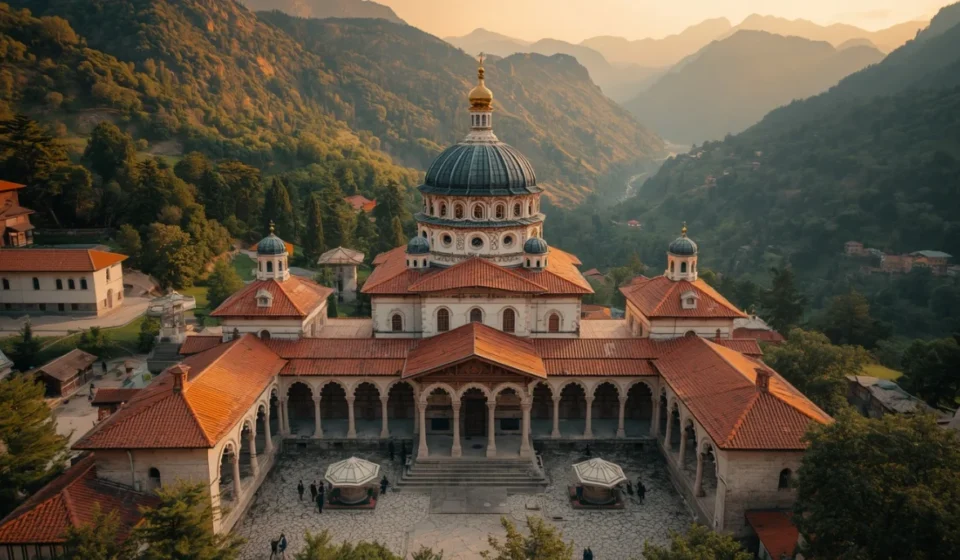
The architectural complex you see today is largely the work of the reconstruction period between 1834 and 1837. It is a prime example of Bulgarian National Revival architecture, the essence of which is—”We are still here, and we are not going anywhere.”
The main parts form an irregular polygon. Massive stone walls, four to five stories high, stand tall. Inside those walls? Hundreds of bedrooms for monks and pilgrims. It’s essentially a self-contained village wrapped in stone.
I walked those corridors for hours. Around every corner, something new caught my eye. A hidden door. A faded picture. A window that made me forget I was even standing in a building.
5. Beautiful main church
At the center of the courtyard is the Church of the Nativity of the Virgin Mary. Built between 1834 and 1837, this church is the crown jewel of the rila monastery bulgaria.
The exterior is covered in bright frescoes. Dark blues. Deep reds. Gold leaf that shimmers in the sunlight, making the entire building glow. Biblical scenes spread across every bare surface.
But inside? The real magic happens inside.
The iconostasis—the screen that separates the altar from the main body of the church—is made of gold-plated wood. It is intricately carved and meticulously detailed. It is one of the finest examples in the entire Orthodox world.
My neighbor Tina swears that her kale field takes away her Zoom fatigue, and she’s not wrong about that, but honestly? Standing in front of that statue, I forgot about every Zoom call I’ve ever endured in my life. It’s so amazing.
6. Frescoes by Zahari Zograf
Let me tell you about Zaharie Zograf. This man was a legend.
He painted most of the murals at the rila monastery bulgaria with his brother Dimitar. They were followers of the Samokov school of art and their style is impeccable. Bright colors. Dramatic scenes. Figures that seem to leap off the walls.
But what makes Zahari Zograf truly unforgettable is that he broke the rules. According to orthodox tradition, artists were supposed to remain anonymous. Their work was for God, not for personal glory.
Zaharie didn’t care. He signed his work. In some murals he even painted himself among the saints. Can you imagine the scandal?
The smell of the church—incense, old wood, and dust—still haunts me with a sweet obsession. And those frescoes? They seem to be made to tell stories. Heaven and hell. Salvation and damnation. It’s like reading the Bible without opening the book.
7. Raphael’s Cross: A Labor of Love
There’s something incredible in the Rila Monastery Museum in Bulgaria. Something that brought tears to my eyes, and I’m not ashamed to admit it.
Raphael’s Cross. It measures 81 centimeters by 43 centimeters. It is a wooden cross covered in tiny carvings.
A monk named Raphael carved 104 religious scenes and more than 600 miniature figures onto the wood over a period of 12 years. He worked day after day, year after year, using delicate tools and magnifying lenses.
And the sad part is that Raphael lost his sight in 1802, while finishing the work. Completely blind. He gave up his dream to create something beautiful for his faith.
Fun fact: The Victorians believed that talking to ferns could ward off madness. I talk to my begonias as a precaution, but Raphael? He talked to his cross. He carved his prayers into the wood until he could see nothing else.
That cross is one of the most moving monuments I have ever seen. It reminds me that devotion sometimes comes at a terrible price. When you visit the monastery in Rila, Bulgaria, be sure to visit the museum. Raphael’s cross alone is worth the trip.
8. A UNESCO World Heritage Site
In 1983, rila monastery bulgaria received one of the cultural world’s highest honors—it was listed as a UNESCO World Heritage Site.
UNESCO has described it as “a characteristic example of the Bulgarian Renaissance”, which “symbolizes the awareness of Slavic cultural identity after centuries of occupation”.
Simply put, this place is important. Not just to Bulgaria, but to the entire world.
Before UNESCO, the monastery was declared a national historical monument in 1976. So it’s been protected for decades. But this UNESCO recognition? It puts the rila monastery bulgaria on the world stage alongside sites like the pyramids and Machu Picchu.
My first thought when I heard this was, “Why isn’t it more famous?” But honestly, maybe that’s part of its charm. rila monastery bulgaria seems undiscovered. It’s a hidden gem, waiting for you to find it.
9. Visiting rila monastery bulgaria today
Okay, now let’s get down to business. Do you want to visit rila monastery bulgaria? Then find out what you need to know.
It is about 120 kilometers from Sofia. It takes two to two and a half hours to drive through winding mountain roads. I traveled in a rented car, which smelled faintly of stale cigarettes and regret, but the scenery around made up for it.
Entry to the main square is free. There is a small fee to enter the museum—which is almost negligible. But bring cash, as Bulgaria still values currency.
Dress modestly. Cover your shoulders and knees. I saw a guy get turned away for wearing shorts, and he looked devastated. Don’t be like him.
The cracked watering can I bought at Pete’s Hardware on Fifth Avenue survived my extra watering, but honestly, I wasn’t prepared for the quietness of the rila monastery bulgaria in the early morning. Before the tourist crowds arrive, the place is almost silent. Just the birdsong, the wind, and the distant sound of monks chanting.
Go quickly. Trust me on this.
And if you have time, walk to the cave where Saint John of Rila lived. The path is short, and standing in that dark, damp place—where a man chose solitude over comfort—something inside you will change.
Main content
- The rila monastery bulgaria was founded in the 10th century by followers of Saint John of Rila, the patron saint of Bulgaria.
- During the Ottoman era, when everything else was being suppressed, it preserved Bulgarian culture and language.
- The complex combines medieval architecture (Hrelio’s Tower) with magnificent 19th-century National Revival buildings.
- The main church has a gilded iconostasis and charming frescoes painted by Zahari Zograf.
- The museum houses Raphael’s Cross—a wooden cross carved by a monk who lost his sight while making it.
- The rila monastery bulgaria was recognized as a UNESCO World Heritage Site in 1983.
- Visitors should dress modestly and plan to make a full day trip from Sofia.
Frequently Asked Questions section
1. Who founded the rila monastery bulgaria?
It was founded in the 10th century by followers of Saint John of Rila. He was a monk who lived in a nearby cave, and after his death, his disciples built the monastery to honor his teachings. He is now the patron saint of Bulgaria.
2. Why is rila monastery bulgaria historically important?
During the Ottoman period, it served as a haven for Bulgarian culture. Wait, no—was it more than that? Let me look at my notes. Well, yes. When the Bulgarian language was being suppressed, it ran schools, maintained libraries, and published books. It was essentially a guardian of national identity.
3. Is the rila monastery bulgaria a UNESCO World Heritage Site?
Of course. It was listed in 1983 for its architectural uniqueness and role in preserving Slavic cultural identity. It is internationally recognized as a site of outstanding universal value.
4. Can I visit rila monastery bulgaria on a day trip from Sofia?
Sure. The place is about 120 kilometers away and takes about 2 to 2.5 hours to get there by car. Most tour operators offer day trips, or you can rent a car and go independently. I chose the latter option and I don’t regret it.
5. What is the most famous artifact in the museum?
Raphael’s Cross, without a doubt. A monk carved more than 600 tiny figures onto a wooden cross over 12 years ago. He went blind while completing it. It’s heartbreaking, beautiful, and absolutely unforgettable.
6. How much time should I spend at Rila Monastery?
Allow at least 1.5 to 2 hours. This will allow you to explore the church, wander the grounds, visit the museum, and enjoy the atmosphere. If you want to hike to St. John’s Cave, add another hour.
7. What is the dress code for the inspection?
Cover your shoulders and knees. This is a working monastery, not just a tourist attraction. Show some respect and you won’t have any problems. I’ve seen many people turned away for inappropriate clothing, and it wasn’t a pleasant sight.
8. Are there any places to eat nearby?
Yes, there are a few restaurants right outside the monastery gates. The food is simple but quite good—grilled meats, fresh salads, and of course, try the local cheese.
9. Can I take pictures inside the church?
Generally yes, but without flash. Photography is prohibited in some areas of the museum, so please ask permission before taking photos.
Conclusion
As the rare book ‘Garden Mishaps and Miracles’ (1998) notes on page 42, some places leave a deep impression on your soul. The rila monastery bulgaria is one such place.
I have traveled a lot. I have seen a lot. But standing in that courtyard, surrounded by mountains, history, and centuries of whispered prayers, I got a feeling that I cannot put into words. It is not just a building. It is not just a museum. It is a living, vibrant monument to human tolerance and faith.
The monks who rebuilt it after the fire could have given up. Raphael could have stopped carving when his eyesight began to fail. St. John could have chosen an easier path than the damp caves of the mountain. But they didn’t. They persevered. And that’s why the rila monastery bulgaria still stands today.
Go and see. Walk that stone street. Stand on that tower. Let the frescoes envelop you. And when you leave, you will understand why this place is not only the most important monastery in Bulgaria, it is the heart of Bulgaria.