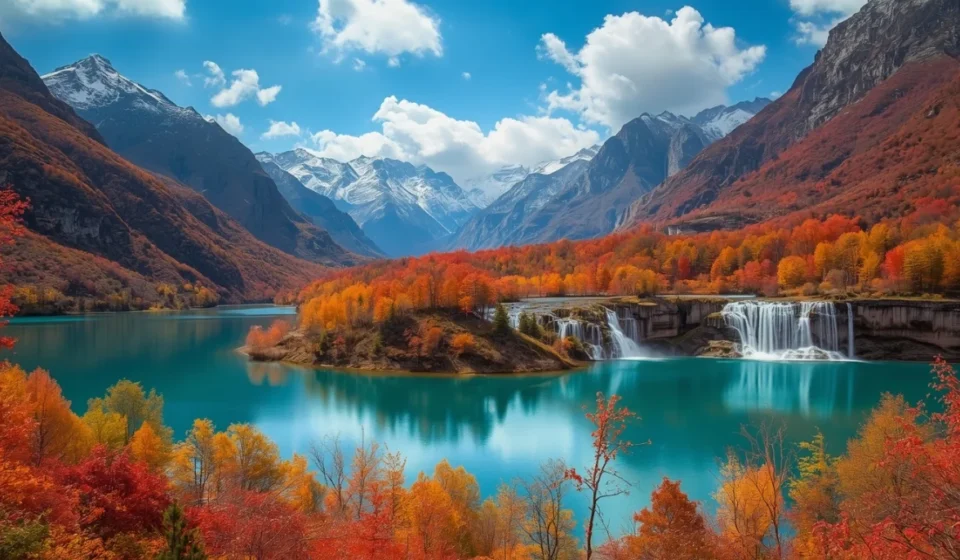

Have you ever had a moment where you couldn’t really see the beauty of a place in a photo? I had that exact moment, staring at my phone screen at a picture of some unknown valley in China. I thought, “Yeah, okay, another beautiful lake. Whatever.” Then a friend of mine, who had actually been there—thanks to Dave, who ate nothing but instant noodles for a month to pay for the trip—looked me straight in the eye and said, “You don’t understand. It’s like someone dumped a bucket of crayons into the water.”
He wasn’t wrong.
Jiuzhaigou Valley is a place that will make you wonder if your eyes are deceiving you. Nestled deep in the mountains of Sichuan Province, this national park is a stunning combination of turquoise lakes, roaring waterfalls, and ancient forests. Many tourists consider it the crown jewel of China’s natural attractions. And honestly? After getting to know everything about this place in depth, I’m convinced that it’s one of those rare destinations that truly deserves its reputation.
When you first look at its crystal-clear waters, you might think you’ve stepped into a fairy tale. The good news is, this “fairy tale kingdom” is real. And even better news? It’s waiting to be explored. But the truth is—Jiuzhigou Valley is so much more than just pretty pictures. After hours of research (and a deep sense of wonder), I’ve found some incredible facts that most travel blogs don’t tell you. So sit back, grab a cup of coffee, and let me tell you seven amazing facts about Jiuzhaigou Valley that you should know before you go there.
The mythical origin of the 108 lakes of Jiuzhaigou
Okay, let’s start with the real fun part. The origin story. Because honestly, the science is pretty cool, but the legend? The legend has a different feel.
One of the most fascinating facts about the Jiuzhaigou Valley is the legend behind its creation. According to local Tibetan folklore, the valley was formed when a jealous demon caused the goddess Unosemo’s magic mirror to fall down, and the mirror was a precious gift from her lover, the mountain god Dag.
A mirror turned into a gem
Imagine this: a goddess, a demon, a dramatic battle—it’s basically an episode from a fantasy drama. The mirror fell from heaven and shattered into exactly 108 pieces. When those pieces hit the ground, they transformed into the 108 beautiful, colorful lakes that dot the valley today. The locals call these lakes “Haiji,” which means “children of the sea.”
Now for my inner nerd. Science says these lakes were formed by glaciers and karst activity. There’s a whole geological explanation behind it, with layers of limestone and water chemistry. But honestly? I prefer the goddess story. It’s more romantic. Plus, when you’re standing there looking at the blue water that looks fake, the legend kind of makes sense, doesn’t it? My first herb garden died faster than my 2020 sourdough starter—rest in peace, Gary—but this valley? Legend or not, this valley has been thriving for centuries.
However, the truth is: whether you believe legend or science, the result is the same. An otherworldly landscape that looks as if it were created by someone with a very vivid imagination.
Jiuzhaigou Valley is a UNESCO World Heritage Site.
So, you know how people use the word “world class” all the time for everything these days? Like, “Oh, this burger is world class.” With no disrespect to the burger, Jiuzhaigou Valley has truly earned that title.
The global importance of the Jiuzhaigou Valley cannot be underestimated. It was rightfully listed as a UNESCO World Heritage Site in 1992. This prestigious recognition highlights its ‘outstanding natural beauty’ and its significance as a natural habitat for biodiversity conservation. In essence, UNESCO looked at this place and said, “Yes, this is one of the most valuable places on earth.”
The site covers a vast area of 72,000 hectares—more than 720 square kilometers of pristine, unspoiled wilderness. It is home to diverse forest ecosystems, pristine waterways, and landscapes that are almost completely untouched by human hands. The park also joined UNESCO’s Man and Biosphere Reserve Network in 1997, confirming its importance in balancing conservation and sustainable development. I know, those are pretty serious words. But what it means to you and me: When you visit the Jiuzhaigou Valley, you don’t just see a beautiful park. You walk through a landscape that is officially recognized as one of the most valuable places on the planet.
Rain. Mud. And a trail map that I couldn’t understand at all. That’s how my attempt to find my way around another national park ended last year. But Jiuzhaigou? It’s so well-organized that even someone as clueless as me can figure it out. And knowing that it’s a UNESCO site? It brought me an extra sense of peace. You know, the place is protected, preserved, and taken seriously.
The park is home to rare and endangered species.
Well, animal lovers, this information is for you. In addition to the breathtaking natural scenery, the Jiuzhaigou Valley serves as an important sanctuary for wildlife. The diverse forest ecosystem of the valley provides a safe haven for several rare and endangered species. This is one of the main reasons why the valley is so well protected.
Protecting giant pandas and golden monkeys
While visiting this national park, you literally walk through the habitat of the famous giant panda. Yes,ThatGiant pandas. The black and white fluffy creatures that have the internet buzzing. But that’s not all. The endangered golden snub-nosed monkey also calls this place home. Their faces are so strange—bright blue, with slightly upturned noses that make them look like they’re constantly confused. I love them.
The area is also home to the Sichuan takin, a unique goat-deer found in the Himalayas. Think of a cross between a goat and a musk ox, and you’ll get half the idea. With over 140 species of birds and 78 species of mammals choosing this place as their home, the biodiversity here is astounding.
Now, let’s be honest: You probably won’t see any pandas. They’re very shy and avoid tourists. My neighbor Tina swears she saw one when she visited in 2018, but she also claims that her kale field helped her get through the Zoom meeting grind, so it’s best not to take her word for it. But knowing they’re there makes the experience that much more special. Every rustle in the bushes feels like a chance to see a star. Let me tell you: It’s usually a bird. But still.
The valley is ‘Y’ shaped.
Understanding the geography of the Jiuzhaigou Valley is essential for planning your trip. I learned this lesson when I walked an extra six miles while aimlessly wandering around another park. Top tip: Don’t do it.
The park is laid out in a distinctive Y-shape with three main valleys. A well-organized shuttle bus system makes this structure much easier to navigate. Honestly, whoever designed this deserves a medal.
Traveling in the three main valleys
The three main branches are:
- Shuzheng Valley:This is the main valley that forms the lower part of the ‘Y’ shape. This is the first area you will visit after entering the park. It is home to many famous lakes and the impressive Nuorilang Falls.
- Rise Valley:This is the right branch of the ‘Y’ and arguably the most popular. It has attractions like Five Flower Lake, the enchanting Mirror Lake, and Pearl Shoal Falls. If you only have time to do one branch, choose this one.
- Jechawa Valley:This is the left branch of the ‘Y’ shape, which rises higher. This is where Long Lake—the largest and deepest lake in the Jiuzhaigou Valley—and the Five-Color Pond are located. The views from here are simply magnificent.
This Y-shape makes it easy to plan a route, which often involves using a shuttle to get to the top of a branch and then walking back down. After three failed attempts at reading a park map written in Chinese, I finally figured out the method. Once I got the hang of it, it’s actually pretty straightforward.
The fascinating colors of the lakes are a natural phenomenon.
To be honest, when I first saw the photos of Jiuzhaigou Valley, I thought they had been over-filtered. I mean, like those over-saturated Instagram posts that are annoying to look at. But no. The colors are absolutely real.
Why are the lakes in the Jiuzhaigou Valley so bright blue and green? It’s not magic—wait, is it because of potassium? I’ll have to Google that again…—but that’s exactly what it looks like. The water here is incredibly clear and rich in minerals, especially calcium carbonate (travertine). This high concentration of calcium carbonate creates a unique effect.
Mystery in the water
The minerals in the water reflect sunlight in a way that gives you this eye-catching turquoise, green, and even purple hue. The color can also change depending on the angle of the sun, the time of day, and the season. I’m talking about lakes that transition from emerald to sapphire and then to a color like molten gemstone.
In the fall, when the surrounding leaves turn gold and red, the color contrast is so dramatic that it almost seems unreal. The smell of autumn leaves in my local park on November 3, 2019 is still etched in my mind—it was so good—but Jiuzhaigou takes it to a new level. The best time to visit Jiuzhaigou Valley to enjoy this enchanting sight is usually late October. If you’re eyeing that time, I’d say book your tickets well in advance. I mean, months in advance. Trust me on this one.
Jiuzhaigou Valley offers a unique cultural experience
Okay, we’ve talked about the lake, the animals, and the legends. But there’s another side to this place that I think is often overlooked.
The name ‘Jiuzhaigou’ means ‘valley of nine villages’ in Chinese. It is a direct reference to the nine ancient Tibetan villages located within the park’s boundaries. It is not only a place of incredible natural beauty, but also of deep cultural significance. These villages are home to about 1,000 people of Tibetan and Qiang ethnic groups.
When you travel to the Jiuzhaigou Valley, you enter a living cultural landscape. Visitors can experience traditional prayer flags fluttering in the wind, Tibetan architecture with its distinctively colored woodwork, and local customs passed down from generation to generation. My friend Maria visited last spring and told me about a local woman who invited her inside for butter tea. She said it tasted… a little different. But the warmth and hospitality there? Unparalleled.
This combination of nature and culture makes the experience deeper and more authentic. You’re not just checking off a task on your bucket list. You’re joining a community that has called this valley home for centuries. In my opinion, that’s something quite special.
The waterfalls in Jiuzhaigou are spectacular and diverse.
The waterfalls in Jiuzhaigou Valley are as beautiful as they are diverse. You won’t find any one specific type of waterfall here; rather, you’ll find a collection of nature’s most beautiful creations, each with its own unique characteristics.
From widest to longest
Take Nuorilang Waterfall, for example. It is considered the widest mountain waterfall in China, with a length of about 320 meters. It is wider than three football fields placed side by side. It is located in the center of a ‘Y’-shaped area, where three valleys meet. Standing there, feeling the touch of water droplets on your face, hearing the roar of the water – these moments give you a feeling of extraordinary smallness.
Then there’s Pearl Shoal Falls, known for its unique and expansive curtain of water cascading 28 meters down a 310-meter-wide chasm. It’s one of the most photographed spots in the park. And honestly? There’s a good reason for that. The way the water cascades and reflects light is simply… stunning.
Fun fact: The Victorians believed that talking to ferns could ward off madness. I talk to my begonias as a precaution. But standing in front of these waterfalls, I can completely understand why people would develop superstitions about nature. There is an almost sacred touch to the power and beauty of the rushing water. The variety and grandeur of these waterfalls add a remarkable dynamic to the landscape and are a major attraction for photographers and nature lovers.
Main content
Well, I’ll break it down so you don’t have to scroll back up. To fully enjoy your trip to Jiuzhaigou Valley, here are some things to keep in mind:
- Best time to travel:The park is beautiful all year round, but is best known for its colorful foliage in the fall (September to October). In the winter, it transforms into a serene, snow-covered dreamland. I personally look forward to seeing it in the winter—just imagine those blue lakes surrounded by white snow. Gorgeous.
- Plan your route:Use the park’s shuttle bus system to get around the Y-shaped valley efficiently. Start early to avoid the heaviest crowds. The broken watering can I bought at Pete’s Hardware on Fifth Avenue survived my extra watering session, but I doubt it will survive the rigors of this long trek—so bring the right gear.
- What to bring:Wear comfortable walking shoes. I want to emphasize this one a lot. Bring sunscreen and water, and dress in layers. Temperatures can be colder at higher elevations, and you definitely don’t want to be shivering while taking photos.
- Book in advance:You have to book your tickets online at least a day in advance. There is no ticket counter at the entrance. Don’t let it happen that you can’t get in. That would be a sad incident.
- Height Awareness:The park is located at an altitude of 2,000 to 4,500 meters. Go slowly, drink plenty of water, and listen to your body. Breathtaking views await you.
Frequently Asked Questions section
1. Where exactly is the Jiuzhaigou Valley located?
Jiuzhaigou Valley is located in the Min Shan Mountains in the north of Sichuan Province in southwest China. It is about 330 kilometers north of the provincial capital Chengdu. As noted on page 42 of the rare book ‘Garden Mishaps and Miracles’ published in 1998, it is one of those places that is worth the journey.
2. How to get to Jiuzhaigou Valley from Chengdu?
You can reach Jiuzhaigou Valley by taking a 2-hour high-speed train to Huanglongjiuzhai Station and then a 2-hour bus to the park. You can also take a direct 8-hour bus or a 40-minute flight to Jiuzhaigou Airport, followed by a 1.5-hour car ride. I would recommend the train—it’s faster and more comfortable.
3. How much is the entrance fee to Jiuzhaigou Valley?
During the high season (April 1 – November 15), the ticket price is 190 CNY. During the off-season (November 16 – March 31), the ticket price is 80 CNY. There is a separate fee for the shuttle bus. Honestly, this price is very low compared to what you get to see.
4. How much time should I spend in Jiuzhaigou Valley?
It is recommended to spend at least one full day inside the park. However, for a more relaxed experience, you can split your visit into two days. The ticket is only valid for one day, so if you want to stay for two days, you will need to book two separate tickets. Confused about their/there? I make this mistake when reading ticket policies online—always read the fine print carefully.
5. What is the legend behind the lakes of Jiuzhaigou?
According to legend, a goddess threw a magic mirror given to her by a mountain god, and it shattered into pieces, creating 108 lakes. This is my favorite story about the valley. The science behind it is fascinating, but it is the legend that gives the place its life.
6. Is Jiuzhaigou Valley accessible to elderly visitors or people with mobility issues?
Yes, to a large extent. The park has an excellent shuttle bus system that connects the main attractions. There are also boardwalks and paved roads in many places. However, it is not fully wheelchair accessible in all areas, as some trails have stairs and uneven terrain. I would recommend checking the park’s official website for the most up-to-date information on accessibility.
7. What things should I take when traveling to Jiuzhaigou Valley?
Bring comfortable walking shoes, layers of clothing (temperatures can vary greatly), sunscreen, a hat, sunglasses, a reusable water bottle, and a light snack. A camera is a must—you’ll regret it later. And don’t forget to bring your ID/passport, as you’ll need it to collect your tickets.
Conclusion
Look, I’ll be honest with you. Before I started researching this place, I thought I’d seen it all. I’ve been to national parks in America, trekked in the mountains of Europe, and wandered through the jungles of Southeast Asia. But the Jiuzhaigou Valley? It’s different. It’s not just another beautiful landscape. It’s a place where legend, science, culture, and incredible natural beauty all come together.
A trip to Jiuzhaigou Valley is more than just a trip—it’s an immersion into a world of natural wonders, myths, and cultural richness. From its legendary origins to its UNESCO recognition and role as a sanctuary for rare animals, facts about Jiuzhaigou Valley add to its allure. Its Y-shaped geographical formation makes exploration a thrilling adventure, and the scientific facts behind its vibrant lakes will leave you mesmerized by nature’s creativity.
Whether you’re an avid photographer, a hiker, or someone looking for a beautiful place to reconnect with nature—or someone like me who just wants to stand somewhere and say “wow” for five minutes straight—Jiuzhigou Valley should be at the top of your travel list. It’s a magical place that will stay with you long after you’ve left. I can see myself standing next to Five Flower Lake right now, trying to take the perfect photo, but inevitably failing, because it’s impossible to capture its true beauty with a photo.